🎉 Waltz reaches $50M💰 in funding to support LATAM growth 🎉 Read the full story here

New York is one of the largest and most established real estate markets in the United States. With more than 8.5 million residents, a diverse economy, a large renter population, and a globally recognized real estate market, New York offers international investors access to one of the country's most dynamic property markets.
For foreign investors, however, investing in New York real estate requires more than choosing a property in a major U.S. city. Property prices, rental income, operating expenses, financing, local regulations, and property type can all have a significant impact on an investment's potential performance.
At the end of 2025, New York City had approximately 13,955 homes for sale, a median asking sale price of $1.025 million, and a median asking rent of $3,874. At the same time, rental inventory remained relatively tight, with 26,238 rental listings, 5.8% fewer than a year earlier.
For international investors considering a New York rental property, the key question is therefore not simply whether New York is a good place to invest. The more important question is whether a specific property, location, rental strategy, and financing structure fit the investor's goals.
This guide explores what foreign investors should know about investing in New York real estate and how to evaluate the market from abroad.
New York has several characteristics that can make it attractive to international investors looking for exposure to U.S. residential real estate.
New York City is the largest city in the United States by population, with an estimated 8,584,629 residents as of July 2025. Its size creates a broad and diverse housing market with demand from professionals, families, students, international residents, and other renters.
For investors, a large renter base can provide multiple opportunities to target different segments of the residential rental market.
At the end of 2025, NYC had 13,955 homes for sale, giving buyers a significant pool of properties to evaluate.
However, New York should not be viewed as one uniform real estate market. Property values, rental demand, regulations, operating expenses, and investment potential can vary substantially depending on the location and property.
Rental demand is one of the key factors to consider when investing in New York real estate.
StreetEasy reported a median asking rent of $3,874 in New York City at the end of 2025. Rental conditions also remained relatively tight, with 26,238 rental listings in December 2025, down 5.8% from the previous year. Meanwhile, median asking rents increased 7.6% year over year.
For investors, strong rental demand can be an important part of the investment equation. However, rental income should always be evaluated alongside the property's purchase price, financing costs, taxes, insurance, maintenance, management, and other expenses.
A property with high monthly rent does not necessarily produce strong cash flow if acquisition and operating costs are also high.
New York's international profile is another factor that can attract foreign investors.
The city is a global center for finance, technology, media, education, tourism, and business. Its international connections also make New York real estate familiar to investors around the world.
For international investors looking to diversify into U.S. real estate, this global visibility can be an advantage. However, familiarity with New York should not replace property-level analysis.
The investment case ultimately depends on the numbers behind each property.
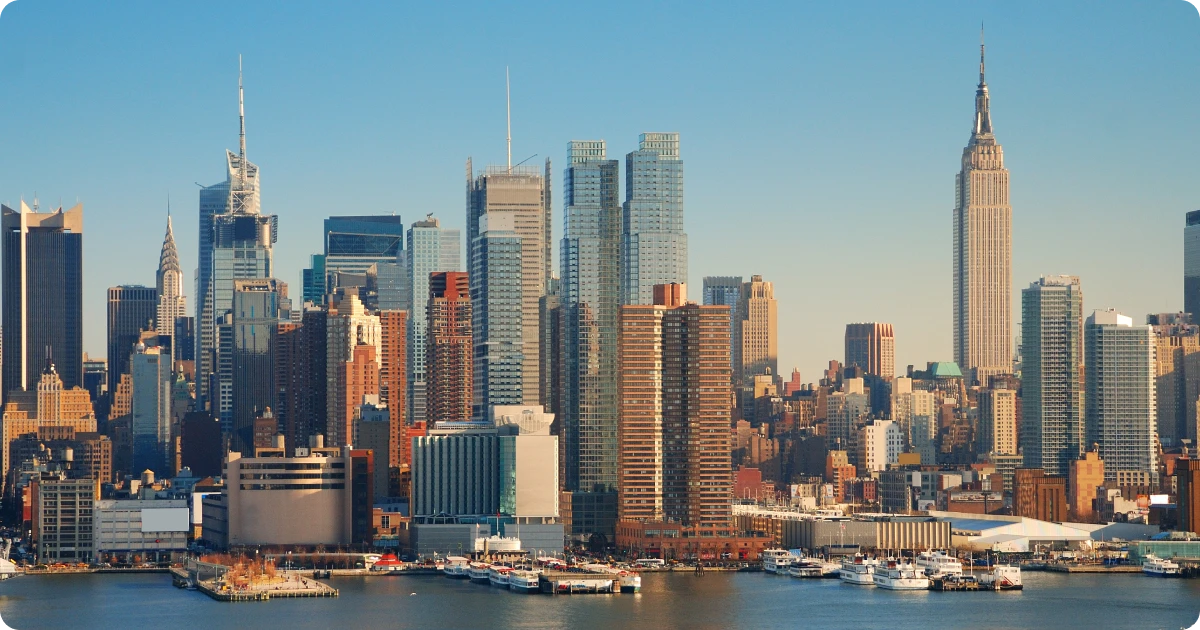
At the end of 2025, sales inventory in New York was 9.3% higher than a year earlier, while the median asking sale price was down 2.4% year over year.
Greater inventory can give buyers more properties to compare and potentially create additional opportunities to negotiate.
For international investors, this makes it particularly important to compare properties based on expected rental income, operating expenses, financing terms, and long-term investment objectives rather than focusing only on the asking price.
New York's 2025 market provides several useful benchmarks for international investors:
Sources: ¹ U.S. Census Bureau, Vintage 2025 Population Estimates. ² StreetEasy, December 2025 NYC Housing Market Report.
These numbers illustrate both the scale of the New York market and the importance of analyzing current market conditions when evaluating an investment property.
New York can offer significant opportunities, but international investors should carefully evaluate the economics and regulatory environment surrounding each property.
New York is a high-value real estate market. The median asking sale price reached $1.025 million at the end of 2025.
For investors, a higher purchase price means that financing structure becomes particularly important.
Instead of evaluating a property based only on its expected appreciation or rental income, investors should consider how the purchase price affects cash flow, leverage, return on invested capital, and long-term portfolio strategy.
Rental income is only one part of the investment equation.
Before purchasing a New York rental property, international investors should account for expenses such as:
These expenses can materially affect the property's net cash flow.
A property with attractive rental income may still produce weaker returns if its operating expenses and financing costs are too high.
New York's real estate market also requires investors to pay close attention to local housing and rental regulations.
Rules governing rent stabilization, property use, renovations, zoning, and short-term rentals can affect how a property can be operated and how much flexibility an owner has.
This is particularly important for international investors who may be evaluating properties remotely and may not be familiar with New York's regulatory environment.
Before purchasing, investors should work with qualified local real estate, legal, and tax professionals to understand the rules that apply to a specific property.
Different property types can have very different investment profiles.
Depending on the location and investment strategy, international investors may consider options such as:
The right property type depends on the investor's objectives, budget, financing structure, expected rental income, and willingness to manage the property.
Rather than assuming one property type is inherently better, investors should compare opportunities based on their projected financial performance.
Invest in New York real estate.
Yes. Foreign nationals can purchase real estate in the United States without being U.S. residents.
However, buying property and obtaining financing are two separate considerations.
International investors may encounter additional challenges when applying for a traditional U.S. mortgage. Some lenders require U.S. credit history, U.S. income documentation, or other financial information that foreign investors may not have.
This is where specialized financing can become particularly relevant.
One financing option available to eligible real estate investors is a DSCR loan, or Debt Service Coverage Ratio loan.
Unlike conventional mortgages that typically focus heavily on the borrower's personal income and credit profile, DSCR financing evaluates the property's ability to generate enough rental income to cover its debt obligations.
A simplified formula is:
DSCR = Rental Income ÷ Total Monthly Debt Service
For international investors, this approach can be particularly useful because the property's income plays an important role in the qualification process rather than relying exclusively on a U.S. salary or U.S. credit history.
For eligible foreign nationals, Waltz offers financing of up to 70% LTV on residential rental properties.
That means an investor may be able to finance a portion of the purchase while preserving some capital for other investments, reserves, or future opportunities.
International investors do not necessarily need to purchase a New York investment property entirely with cash.
For eligible investors, financing can provide leverage while potentially allowing them to preserve capital for additional investments.
Waltz provides a digital financing process designed for international investors, including DSCR-based mortgage financing of up to 70% LTV on eligible residential rental properties.
The platform also brings together several of the services that international investors may need when purchasing U.S. real estate:
For foreign investors, combining these steps into a more streamlined process can help reduce some of the complexity involved in purchasing property from another country.
One of the biggest challenges for international investors is not necessarily finding a property. It is coordinating everything that happens after identifying an investment opportunity.
An investor may need to establish a U.S. legal entity, obtain an EIN, open a U.S. bank account, transfer funds, secure financing, arrange insurance, coordinate with professionals, and complete the closing process.
Technology has made it possible to manage much of this process remotely.
With Waltz, eligible investors can complete key parts of the investment journey digitally. The Waltz Investor Kit includes U.S. LLC formation, EIN registration, and an FDIC-insured U.S. bank account. Investors can also access foreign exchange and mortgage financing through the platform.
Eligible investors can complete a paperless closing from abroad, with Waltz stating that qualified transactions can close in as little as 14 days.
New York offers international investors access to one of the largest and most established residential real estate markets in the United States.
With more than 8.5 million residents, nearly 14,000 homes for sale at the end of 2025, a $1.025 million median asking sale price, and a $3,874 median asking rent, the market offers substantial opportunities, but also requires careful analysis.
Before purchasing a New York investment property, foreign investors should evaluate the neighborhood, property type, rental income, operating expenses, taxes, insurance, local regulations, and financing terms.
For eligible international investors, DSCR financing can provide an alternative to traditional mortgage structures by placing greater emphasis on the property's rental income rather than U.S. employment income or credit history. Waltz offers eligible foreign nationals financing of up to 70% LTV on residential rental properties.
With the right property, financing structure, and investment strategy, New York can be a compelling addition to an international real estate portfolio.
Looking to invest in New York real estate? Get started with Waltz today.

Fill out a quick form and we'll get back to you shortly.


