For real estate investors, buying a property is the first step in building their wealth. The real opportunity comes from turning that property into an income-producing asset and using the equity it builds to finance future investments and scale.
That's the idea behind the BRRRR strategy: Buy, Rehab, Rent, Refinance, Repeat. While each stage plays an important role, the Rent and Refinance steps are particularly critical. They determine whether an investor can turn a renovated property into a source of recurring income and unlock capital for the next acquisition.
For foreign investors looking to build a U.S. rental property portfolio, however, refinancing can be one of the biggest challenges. Traditional lenders often rely on U.S. credit histories, domestic income documentation, and residency requirements, making it difficult for international buyers to access the equity they've created.
With rental-income-based financing, such as Debt-Service-Coverage-Ratio (DSCR) loans, investors have another way to approach this process.
In this blog, we'll explore how the Rent and Refinance stages work, what lenders look for, and how foreign investors can use rental income and property equity to support their next U.S. real estate investment.
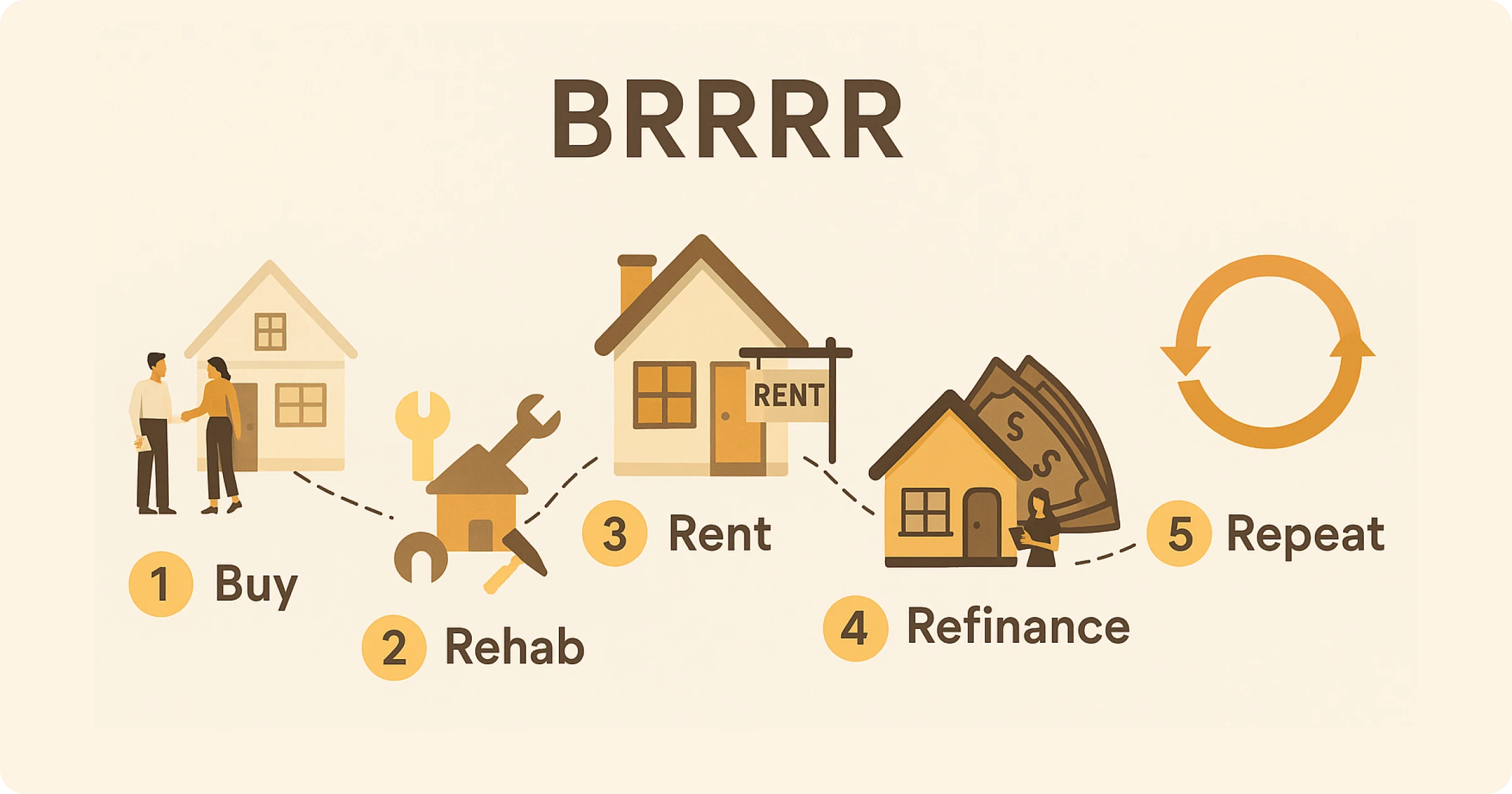
The BRRRR method is designed to make investment capital work more than once. Instead of purchasing a property, holding it indefinitely, and leaving all your money tied up in that asset, you can potentially access some of its equity after increasing its value and establishing rental income.
The process relies on two important outcomes:
Together, these two elements can create a repeatable investment strategy. Rental income supports the property's financial performance, while refinancing can provide capital for another purchase, renovation, or investment opportunity.
For international investors, having access to both reliable property management and financing designed for foreign nationals can make this strategy considerably more practical.
Explore your refinancing options with Waltz.
After purchasing and renovating a property, the next objective is to make it rental-ready and generate consistent income.
This stage is about more than finding a tenant. The property's rental performance will influence its long-term profitability and may directly affect your ability to qualify for refinancing.
Setting a competitive rental price is essential. An asking rent that's too high can increase vacancy periods, while pricing too low may reduce your potential returns.
Before listing the property, research comparable rentals in the same neighborhood. Consider:
The goal is to find a balance between maximizing rental income and maintaining consistent occupancy.
Rental revenue is only one part of the equation. Investors also need to account for property taxes, insurance, HOA fees, maintenance, property management, and mortgage payments.
Understanding these expenses helps determine how much income the property actually generates and whether it can comfortably support its financing obligations.
This is particularly important when preparing for a DSCR refinance.
The Debt-Service-Coverage Ratio measures a property's ability to cover its debt obligations through its income. Depending on the lender's calculation, qualifying rental income is evaluated against expenses associated with the property's debt service.
A DSCR above 1 generally indicates that the property's income exceeds its debt obligations under the applicable calculation.
For example, if a rental property generates $3,500 per month in qualifying income and its monthly debt obligations are $2,800, its DSCR would be approximately 1.25.
The stronger the property's cash flow, the better positioned it may be for income-based financing.
For foreign investors, managing a rental property remotely adds another layer of complexity.
A local property manager can help with:
Keeping organized records is equally important. Lease agreements, rental statements, bank deposits, and expense documentation can help demonstrate the property's performance during the refinancing process.
A well-managed rental property is not only easier to operate from abroad; it also provides a clearer financial picture when it's time to refinance.
Once a property has been renovated, rented, and is generating income, investors may be able to refinance it and access a portion of the equity they've built.
This is where the BRRRR strategy creates an opportunity to recycle investment capital.
A cash-out refinance replaces an existing mortgage, or establishes new financing on a property owned free and clear, allowing investors to access some of the property's equity without selling the asset.
However, property equity is not the same as cash available to withdraw. The maximum loan amount is generally determined by the program's loan-to-value (LTV) limits and the lender's underwriting requirements. To calculate the actual cash proceeds, investors must also account for any existing mortgage balance, outstanding liens, other payoff amounts, and closing costs.
The calculation can be summarized as follows:
Estimated Net Cash-Out = Approved New Loan Amount − Existing Mortgage Payoff − Other Liens and Payoff Amounts − Closing Costs
For example, a property may have substantial equity, but the amount an investor can actually access will depend on the approved loan amount and the costs associated with refinancing.
Rather than selling the property to access its equity, investors can potentially retain ownership, continue collecting rental income, and use the refinance proceeds to fund their next real estate investment.
Two factors generally play an important role in determining how much an investor may be able to borrow:
1. The property's appraised value
After renovations, the property is evaluated to determine its current market value. This is often referred to as its After-Repair Value (ARV) in the BRRRR strategy.
The higher the appraised value compared to the original acquisition and renovation costs, the more equity the investor may have created.
2. The loan-to-value ratio (LTV)
The LTV measures the loan amount against the property's appraised value.
For example, if a property is appraised at $400,000 and the applicable refinancing program allows a 80% LTV, the potential loan amount would be up to $320,000, subject to underwriting and the property's qualification.
However, the appraised value alone doesn't determine the final loan amount. The property's rental income, DSCR, loan terms, and other eligibility requirements also matter.
Imagine an international investor purchases a U.S. rental property for $250,000 using cash and invests another $50,000 in renovations.
After completing the improvements, the property is appraised at $400,000 and rented to a tenant for $3,500 per month.
The investor now has a renovated, income-producing property with an increased market value.
If the applicable financing program allows a 80% LTV, the potential refinance amount could reach $320,000.
Here's how the numbers compare:
In this simplified example, the investor could potentially recover a substantial portion of the original $300,000 investment while retaining ownership of the rental property.
The actual cash received would depend on underwriting, existing liens, closing costs, and the final approved loan amount.
The investor can then consider using the available proceeds toward another U.S. property, beginning another renovation project, or expanding their rental portfolio.
This is the fundamental advantage of the BRRRR approach: instead of starting from scratch with new capital for every purchase, investors can potentially reuse capital generated through previous investments.
Even when a property has strong rental income and significant equity, refinancing can be complicated for investors who don't live in the United States.
Traditional mortgage applications often require U.S. credit scores, domestic income verification, tax returns, and other financial documentation that international buyers may not have.
This creates a disconnect: an investor may own a profitable U.S. rental property but still struggle to qualify for a traditional refinance.
DSCR loans offer an alternative by focusing on the property's ability to generate enough income to support its debt obligations.
For foreign nationals, one of the main advantages of DSCR financing is that qualification can be based on the rental property's financial performance rather than the borrower's U.S. employment or credit history.
With Waltz, foreign investors can explore refinancing options without a U.S. credit score or U.S. income verification.
This makes the process more accessible to international property owners who want to leverage their existing U.S. real estate investments.
Selling a property is not the only way to access the equity you've accumulated.
A cash-out refinance can allow investors to unlock part of their property's value while retaining ownership and continuing to generate rental income.
With Waltz, eligible foreign investors can access cash-out refinancing options of up to 70% LTV, depending on the property, loan program, and underwriting approval.
International investors shouldn't have to travel to the United States every time they need to manage a financing transaction.
Waltz combines mortgage financing with a digital platform designed to simplify the investment process for foreign nationals.
From refinancing applications to documentation and closing, investors can manage much of the process remotely, with support throughout the transaction.
Planning ahead can help avoid delays and make the refinancing process smoother.
Before applying for a cash-out refinance, consider the following:
One important consideration is the seasoning period, which refers to how long an investor must own a property before becoming eligible for certain refinancing options. Requirements vary depending on the loan program and whether the refinance is based on the property's cost basis or its after-repair value.
Understanding these conditions early can help investors plan their renovation timelines, rental strategy, and expected access to capital.
The real potential of the BRRRR strategy becomes clearer when investors look beyond a single property.
Once a rental property is stabilized and successfully refinanced, the capital released may help fund the next acquisition.
The same process can then be repeated:
Over time, this approach can help investors build a diversified U.S. rental portfolio without relying exclusively on new savings for every acquisition.
Of course, each new investment needs to stand on its own financial merits. Additional debt, interest expenses, vacancy periods, maintenance costs, and market fluctuations all affect returns. Refinancing also reduces the equity retained in the property.
The key is to make sure that every property has sustainable cash flow and that the financing structure supports the investor's long-term objectives.
The Rent and Refinance stages are what connect a renovated property to the next investment opportunity. Consistent rental income helps establish the property's financial performance, while refinancing can turn accumulated equity into capital for future acquisitions.
DSCR financing makes refinancing more accessible to foreign investors by focusing on rental income rather than U.S. credit history or domestic income verification. The process can be completed remotely, with basic documentation such as a passport, property records, lease agreements, and LLC documents, if applicable.
Waltz helps international investors finance U.S. rental properties through DSCR-based lending, with options for rate-and-term and cash-out refinancing. Our digital platform also simplifies the process of managing U.S. real estate financing from abroad.
Your property's equity could be the starting point for your next U.S. real estate investment. Explore how much your capital is worth in U.S. dollars and plan your next move with Waltz.
Calculate your investment in USD.

Fill out a quick form and we'll get back to you shortly.


